Performance versus Learning

Performance Versus Learning
Your reflection question asked you to imagine returning to a topic six weeks later. If you found yourself uncertain about how well your students would perform, you are not alone — and that uncertainty points to something important.
What students can do at the end of a lesson and what they have truly learned are not the same thing. Dylan Wiliam, drawing on the memory research of Robert Bjork, identifies this as one of the most important and most overlooked distinctions in teaching.
Four Propositions About Learning
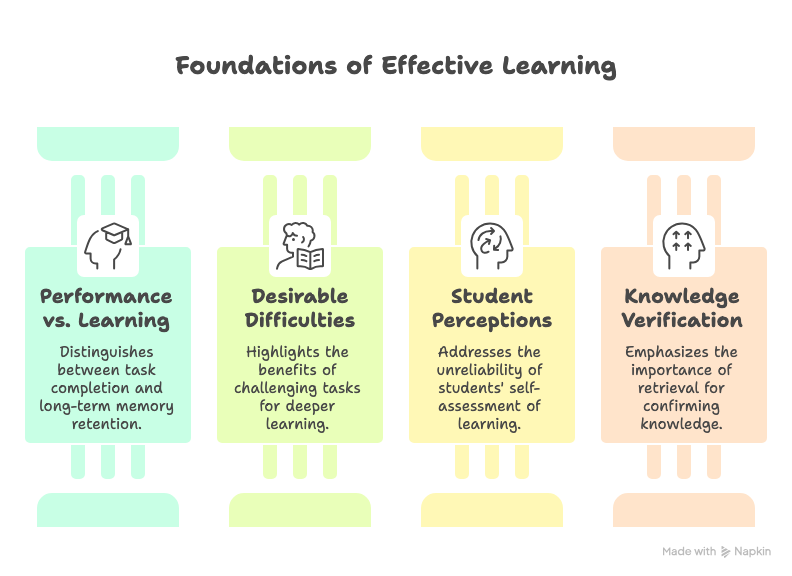
Wiliam summarises the research in four propositions that he believes are all true — and all routinely ignored in everyday classroom practice:
1. Performance and learning are different things. A student can complete every task in a lesson perfectly and yet two weeks later show no trace of that learning. Every teacher has experienced this. It is not that the lesson failed — it is that completion of a task and transfer into long-term memory are entirely separate events. As Wiliam puts it, it is as though the men in black have arrived with their memory erasers between one lesson and the next.
2. Learning and performance are often inversely related. This is the counterintuitive one. When teaching makes things easy — when students breeze through a task with little effort — performance in the lesson looks good, but long-term learning is often shallow. Conversely, the things that make a task harder in the moment — requiring students to struggle, retrieve, connect and apply — tend to produce stronger long-term learning. Bjork calls these desirable difficulties: making things hard on yourself, but in a good way.
3. Students do not reliably know when they are learning. Research consistently shows that students' perceptions of whether they are learning are often wide of the mark. In fact, students tend to express a preference for teaching approaches that feel easier — and those approaches are frequently the least effective for long-term retention. Wiliam draws on a relatable example: how many times have you put something in the freezer without labelling it, absolutely certain you would remember what it was — only to find a mysterious frozen block six weeks later? The certainty felt real. The memory did not last.
4. Students do not reliably know when they know something. The only truly reliable test of whether something is known is to attempt to retrieve it from memory. Students — and teachers — cannot simply introspect their way to a reliable answer.
What This Means for Learning Intentions
These four propositions have a direct bearing on how we think about learning intentions and success criteria. If performance in the lesson is not a reliable indicator of learning, then a learning intention that is satisfied by task completion alone is not doing its job.
The goal is not for students to finish the worksheet. It is not even for them to score well on Friday's test. It is for their long-term capability to genuinely increase — for something durable to have changed in what they can do and understand. That is what teaching as an intentional activity actually means.