When to Share Learning Intentions

When to Share Learning Intentions
We have established that the teacher must always be clear about the learning intention. That clarity is non-negotiable — it is what makes teaching an intentional activity rather than a series of loosely connected tasks. But whether, and when, to share that intention with students is an entirely separate question.
Dylan Wiliam is direct on this point: deciding when to share a learning intention is a professional judgment best left to the teacher. There is no evidence that simply writing a learning intention on the board at the start of every lesson improves student learning. What matters is that the sharing of it is deliberate and purposeful.
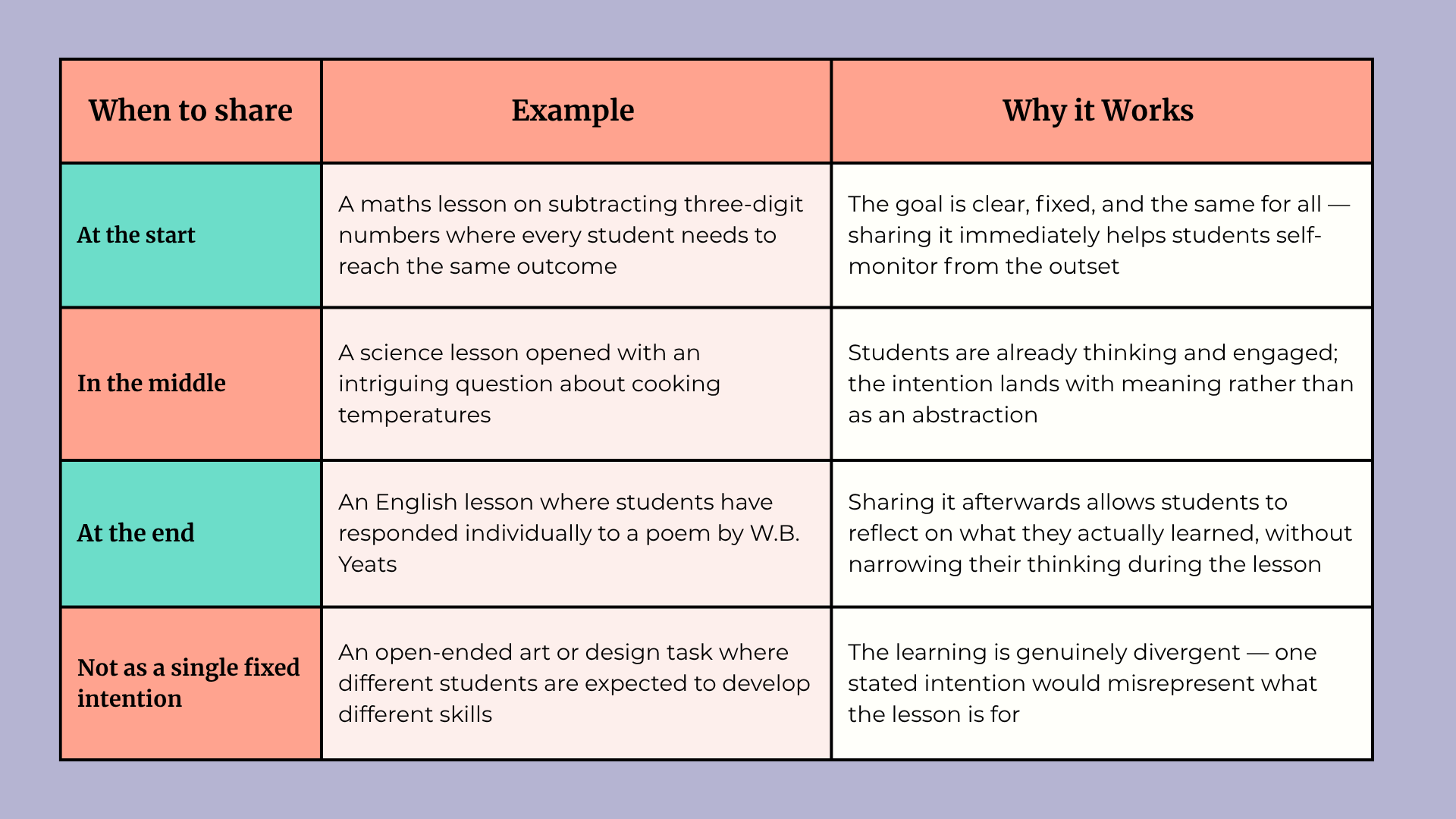
Wiliam identifies three types of lesson where sharing the intention at the outset may not be the right decision:
1. Exploratory lessons Not every lesson has a single, fixed destination. If students are responding to a poem, analysing a piece of art, or investigating an open-ended question, it may be entirely appropriate for different students to learn different things. Stating a single learning intention too early can artificially narrow that space.
2. Lessons where the discovery is the learning Sometimes, telling students where they are going spoils the journey. If the point of the lesson is for students to arrive at a conclusion through their own thinking, revealing it upfront removes the very cognitive work you were trying to create.
3. Lessons that need engagement before clarity As we explored in the previous lesson, students are not always ready to engage with an abstract goal the moment they arrive. In these cases, the learning intention is best shared once curiosity has been established — once students are already thinking about the right things.