Engaging Students First

Engaging Students First
The reason so many of us struggle to answer the above question confidently is that we have been taught to begin with the destination — and then hope students want to go there.
Dylan Wiliam is clear: students do not arrive at our classrooms motivated. A lot of the time, they would rather be somewhere else. And no student has ever walked in excited by an extract from a national curriculum document. What the most effective teachers do is create the motivation — through the way they open the lesson — before the learning intention is ever shared.
This does not mean abandoning learning intentions. It means making a deliberate, professional decision about when and how to share them. The learning intention belongs to the teacher from the outset. It does not always need to be the first thing students see.
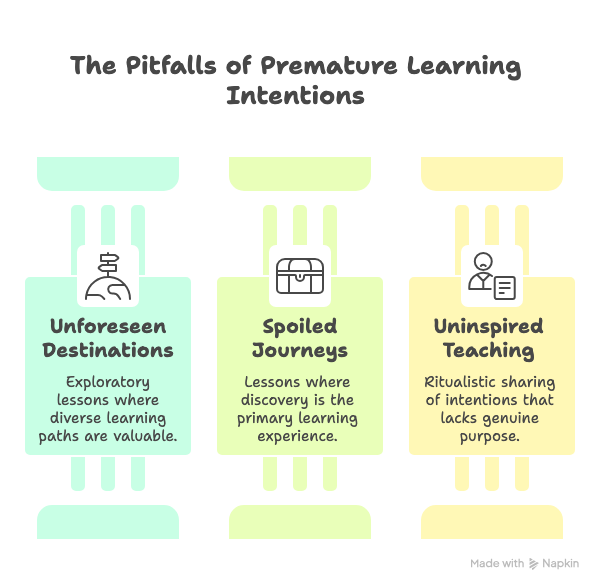
So what should come first?
Lead with something that makes students want to think. Some practical approaches:
- An intriguing question — Science: "Why does it take longer to cook potatoes in an oven at 220°C than in boiling water at 100°C?" | Maths: "Is a square a trapezium?" | History: "Was the person who shot Archduke Franz Ferdinand a hero or a terrorist?"
- A provocative statement — Research shows that declarative statements often produce longer, more thoughtful responses than direct questions. Try "Nuclear energy is the greenest power source we have" or "It is never acceptable to break the law" and let students argue.
- Something unexpected — A counterintuitive fact, a surprising image, a result that seems impossible. Confusion, when carefully designed, is one of the most powerful engagement tools a teacher has.
- Immediate personal relevance — "You ate breakfast this morning. Where exactly is it right now?" | "You've been offered two jobs. One pays £25,000 a year. One pays £2,500 a month. Which do you choose?"
Teaching with intention does not start with writing the objective on the board. It starts with making students care.