Key Takeaways

Module 1: Key Takeaways
Why Questions Matter
- There are two good reasons to ask a question: to cause thinking and to collect evidence that informs next steps
- Better evidence leads to better decisions — and better decisions lead to better learning
- Learning is a long-term change in capability; the questions we ask are our best available tool for gauging where students are right now
Closed, Open and Everything In Between
- The important distinction is not between closed and open questions — it is between low-order recall and high-order thinking
- A well-designed closed question can be more powerful than an open one if it causes genuine reasoning or surfaces a specific misconception
- Plan your questions with a colleague — you cannot think up good questions on your own
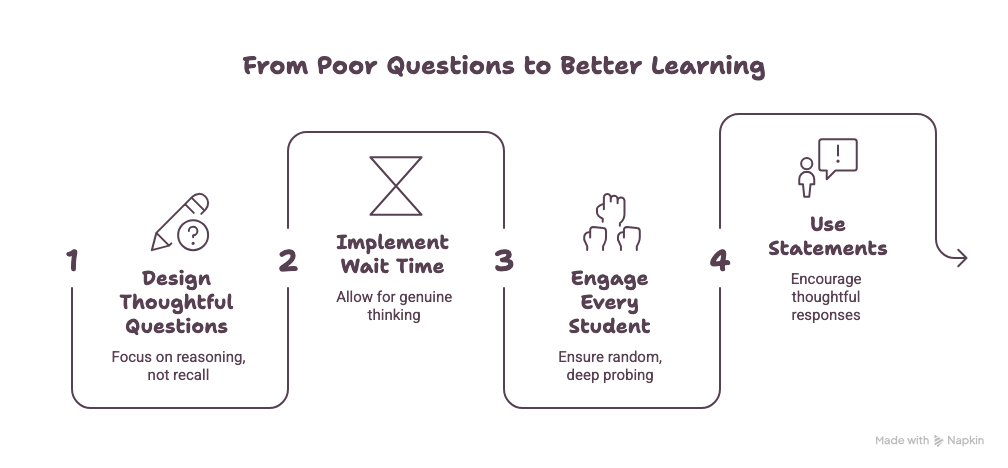
The Power of Wait Time
- The average teacher wait time is 0.9 seconds — not nearly enough for genuine thinking to take place
- There are two wait times: the gap before a student answers, and the gap before the teacher evaluates — both matter
- In think-pair-share, do not skip the think — silent individual thinking strengthens memory before the discussion begins
Hearing from Every Student
- Most teachers make decisions about a whole class based on the responses of one or two confident volunteers — this is not sufficient evidence
- No hands up ensures every student remains engaged — the teacher, not the student, decides who responds
- Use a randomisation device to ensure truly random questioning, and use hot seat questioning to probe thinking in depth
Try a Statement Instead
- When teachers make statements rather than asking questions, students tend to give longer and more thoughtful responses
- You can be wrong answering a question — you cannot be wrong responding to a statement
- A pushback, a restatement or a simple expression of interest can elicit richer thinking than a direct question
In the Next Module
We have spent Module 1 exploring how to ask better questions and gather better evidence from every student. In Module 2, we turn to a more specific and powerful tool: the hinge question. You will learn how to design diagnostic questions that reveal what students actually understand at critical moments in a lesson — and how to use that evidence to make better real-time teaching decisions.