Hearing From Every Student

Hearing from Every Student
In the previous lessons we have looked at what makes a good question and how to give students the time to think. But there is a third problem that even the best question, asked with plenty of wait time, cannot solve on its own: the evidence you gather is only as good as the sample of students you gather it from.
Dylan Wiliam is direct about this. The most common instructional decision a teacher makes every day is: do I need to go over this one more time, or can I move on? Most teachers make that decision by asking a question and selecting one of the students who raises their hand. As Wiliam puts it — how smart is that? Making a decision about the learning needs of thirty or thirty-five students based on the responses of one or two confident volunteers.
The solution is not complicated. It is simply this: get evidence from every student, not just the usual suspects.
The Problem with I-R-E
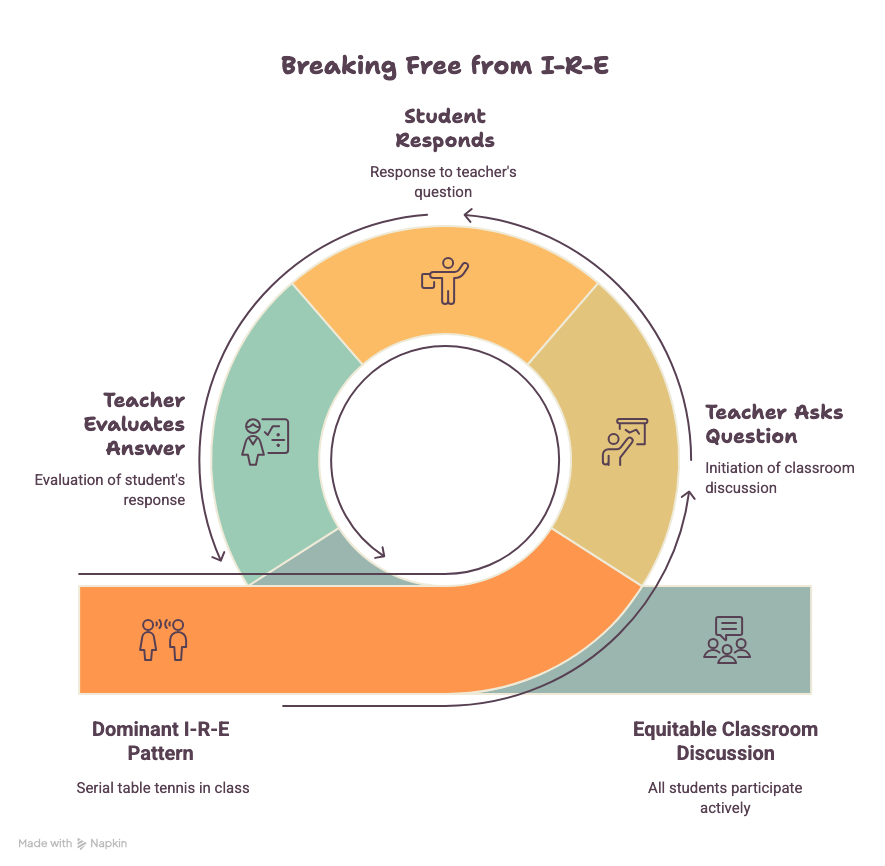
The dominant pattern of classroom questioning — what researchers call Initiation-Response-Evaluation, or I-R-E — works like this:
- The teacher asks a question (initiation)
- A student responds (response)
- The teacher evaluates the answer (evaluation)
- Repeat
The conversation bounces back and forth between the teacher and one student at a time — what Wiliam describes as serial table tennis. The same students dominate. The rest disengage. And the teacher makes decisions about the whole class based on the responses of the few.
Breaking out of this pattern does not require abandoning structure. It requires redistributing who speaks, when, and on whose terms.
No Hands Up
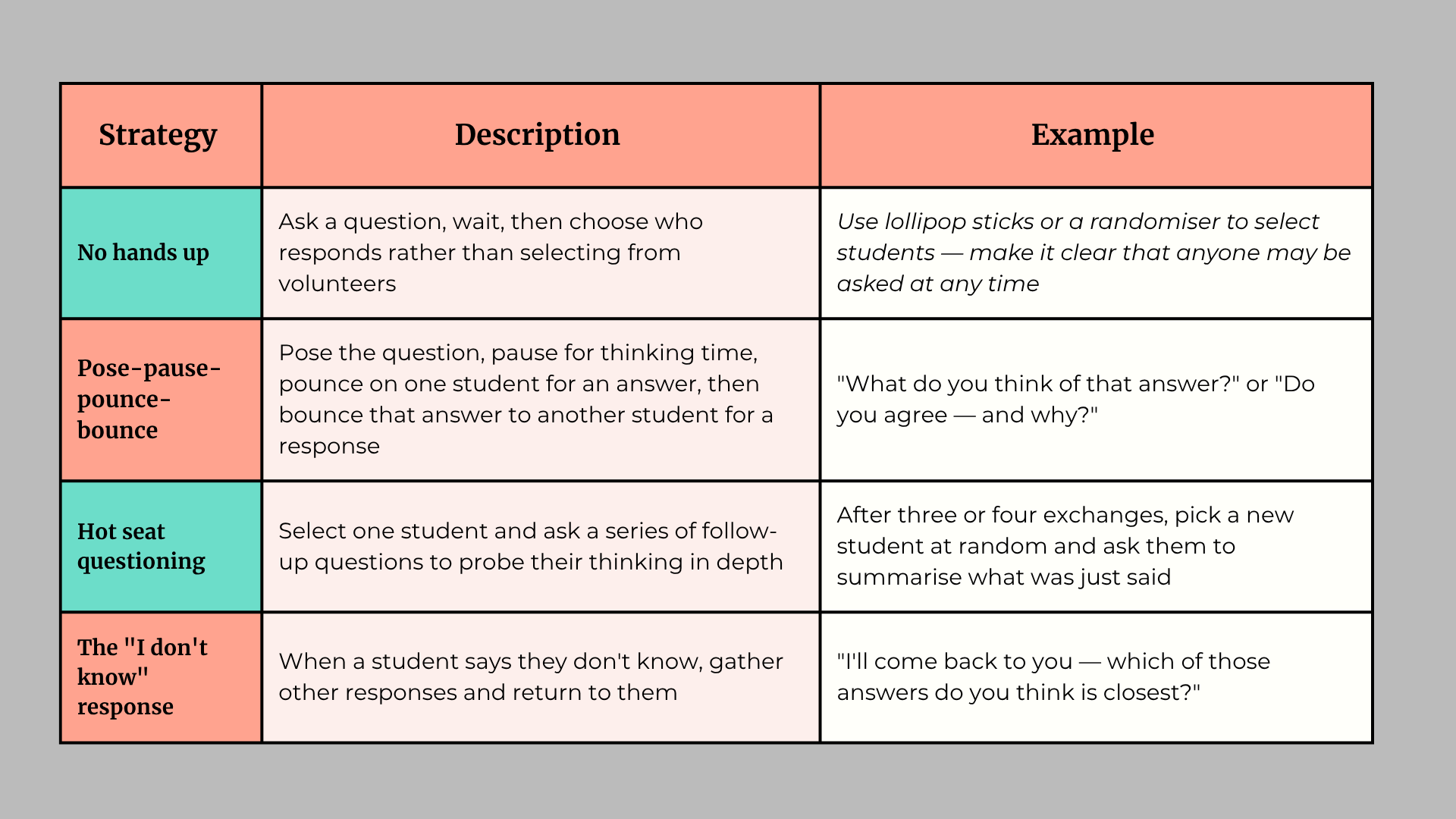
One of Wiliam's most well-known recommendations is deceptively simple: no hands up, except to ask a question.
Rather than selecting from students who volunteer, the teacher asks a question, gives students time to think, and then chooses who responds. This small change has a significant effect: students who previously opted out by keeping their hands down now know they may be called upon at any moment — which means they have to stay engaged.
Everybody dislikes no hands up initially. Teachers dislike it because it disrupts familiar routines. Lower-achieving students dislike it because they can no longer disappear. But the students who dislike it most of all, Wiliam notes, are the highest achievers — because they can no longer guarantee they will only be called on when they are certain of the answer.
In a BBC experiment Wiliam conducted called The Classroom Experiment, one high-achieving student — William — was asked what he had noticed after his class adopted no hands up. His response: "I never knew my classmates were so smart." When students can no longer hide, the classroom becomes a more honest — and more cohesive — place.
What to do when a student says "I don't know"
This is the moment most teachers find uncomfortable. Wiliam's recommendation is not to accept it and move on — that simply allows the student to opt out. Instead, move around the class gathering other responses, then return to the original student and ask: "Now, which of those answers do you think is closest?" Even if the class has given a single correct response, returning to the original student to ask them to repeat or explain it reinforces that there are no opt-outs.
Randomisation
Teachers generally believe they can call on students at random — but the evidence suggests they cannot. When the lesson is moving quickly, teachers are instinctively drawn to students they trust to give a good answer. Wiliam recommends using a randomisation device — lollipop sticks with student names, cards, or a randomiser built into interactive whiteboard software — to ensure that every student genuinely believes they might be called upon at any moment. It does not matter precisely how the randomisation is done. What matters is that every student feels the possibility.
Hot Seat Questioning
As an alternative to constant randomisation — which can produce a flat, ping-pong style of dialogue — Wiliam recommends occasionally using hot seat questioning: selecting one student and asking them a sequence of follow-up questions to probe their thinking in depth.
This keeps the rest of the class engaged — because they know that as soon as the hot seat student finishes, a new student will be chosen at random and asked to summarise what they just heard.