The Usual Suspects: Why Your Best Evidence Might be Your Worst Sample

The Usual Suspects: Why Your Best Evidence Might Be Your Worst Sample
Dylan Wiliam began his teaching career in the 1970s. And like most teachers, he had a habit he was not even aware of.
Every lesson, dozens of times a day, he faced the same decision: do I need to go over this one more time, or can I move on? To answer that question, he would ask the class a question. A few hands would go up. He would pick one. The student would answer correctly. He would say "good" — and move on.
It was only years later that he stopped to ask himself the question nobody had ever asked him:
Was what that one student said a good guide to what was happening in the heads of the other thirty-four students in the room?
The answer, of course, was no.
And yet this is what teachers all over the world still do every day — making decisions about the learning needs of a diverse group of students based on the responses of one or two confident, articulate volunteers. The same students. Every lesson. The usual suspects.
This is not a criticism. It is a structural problem with how most classroom questioning works — and it has a straightforward solution. If better evidence leads to better decisions, and better decisions lead to better learning, then the most important question in your classroom is not the one you ask your students.
It is whether you are asking it of all of them.
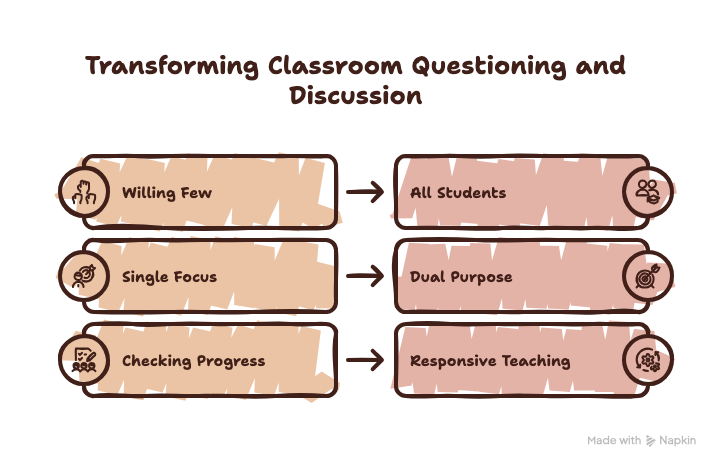
The Real Purpose of This Course
This course, grounded in Dylan Wiliam's research, will help you move past the habit of relying on the willing few — and into a more deliberate, evidence-rich approach to classroom questioning and discussion. It is built around three interconnected goals.
1. The Art of Questioning
We will begin by examining what questions are actually for. There are two good reasons to ask a question in a classroom — to cause thinking and to gather evidence — and most teachers are only reliably achieving one of them. You will evaluate your current questioning habits and identify practical changes you can make immediately.
2. Hinge Questions and Diagnostic Tasks
Knowing that you need better evidence is one thing. Knowing how to design questions that reliably generate it is another. You will explore the design principles of effective hinge questions — the checkpoint questions that reveal in seconds whether your class is ready to move on, or whether you need to do something different.
3. Engineering Productive Classroom Discussion
Finally, we will look at what it takes to build a classroom culture where evidence of learning flows freely — where all students share their thinking openly, and where discussion is not just engaging but genuinely informative for the teacher.
Because when questioning and discussion are done well, they do not just check whether students are keeping up. They become the engine of responsive, effective teaching — minute by minute and day by day.