Closed, Open and Everything In Between

Closed, Open and Everything In Between
At some point in their training, most teachers will have been told the same thing: closed questions are bad, open questions are good. It is a tidy rule — and according to Dylan Wiliam, it is also wrong.
The distinction between closed and open questions is far less important than it might seem. What actually matters is whether a question causes students to think — or whether it simply asks them to retrieve something they already know.
The Real Distinction: Low Order vs. High Order
Wiliam identifies the more useful distinction as one between low-order and high-order questions:
- Low-order questions ask for factual recall. How many sides does a pentagon have? How many legs does an insect have? These are not bad questions — factual knowledge matters — but they do not require students to think in any new way. They simply ask students to retrieve what they already know.
- High-order questions require students to think about something they have not thought about in quite this way before. Is a square a trapezium? is technically a closed question — there are only two possible answers. But most students have never considered it, which means they have to engage with the definitions of both shapes, compare them, and reason their way to a conclusion. That is thinking. And thinking is what produces learning.
Research suggests that teachers ask approximately five times as many low-order questions as high-order ones. That imbalance is worth reflecting on — not because low-order questions are wrong, but because high-order questions are what generate the evidence of understanding that teachers most need.
![]() Closed Questions Can Be Powerful
Closed Questions Can Be Powerful
 Closed Questions Can Be Powerful
Some of the most effective diagnostic questions are closed. Consider this example Wiliam uses: "Which way does light travel — from my eye to what I am seeing, or from what I am seeing to my eye?"
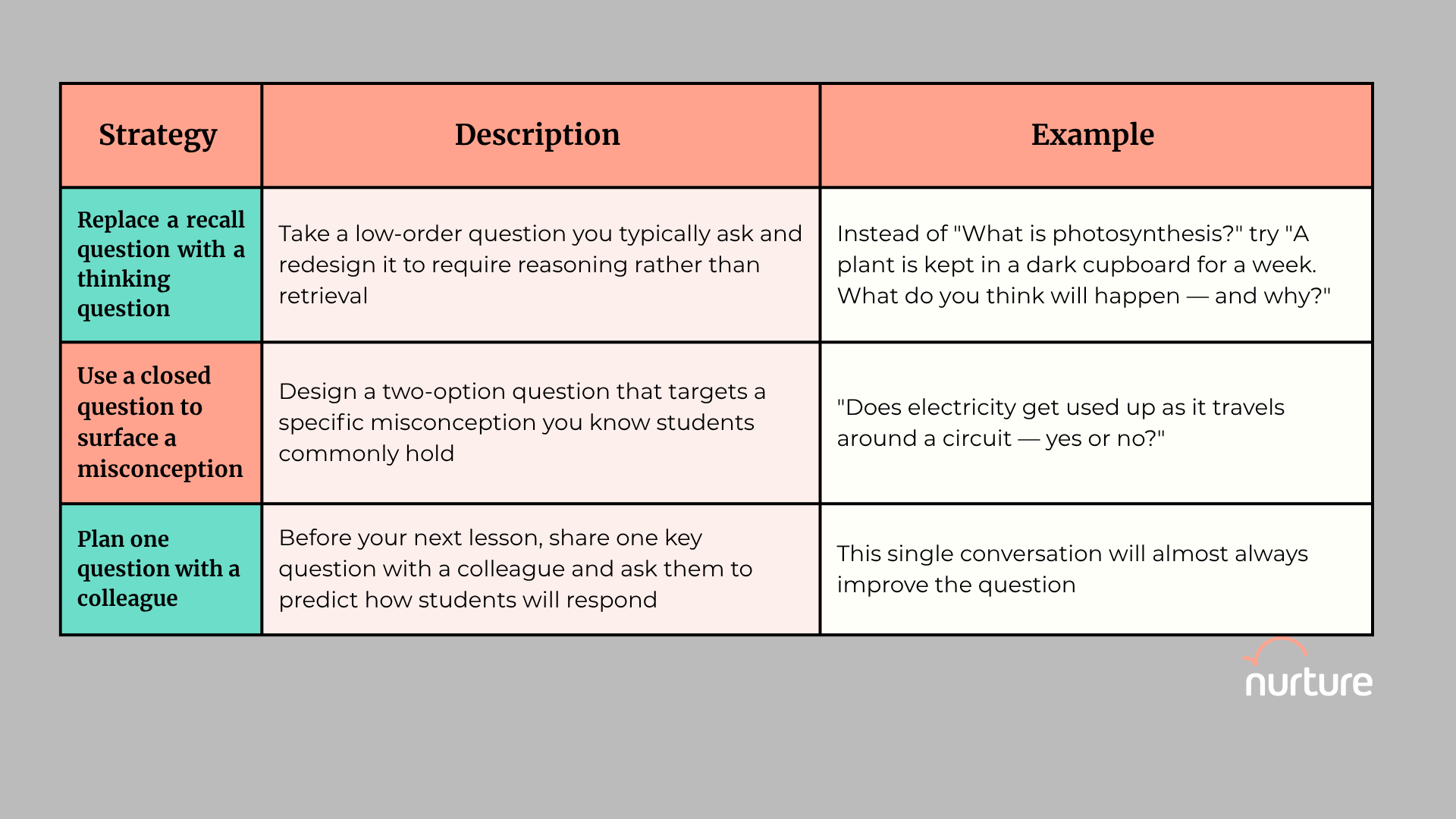
There are only two possible answers. But the question is worth asking precisely because many students hold the misconception that light radiates outward from the eye. A closed question, well designed, can surface a specific misconception far more efficiently than an open one — because it forces every student to commit to a position.
The same principle applies to questions designed to cause thinking: "Is a square a trapezium?" is closed, but it sends students straight into genuine reasoning. Whether a question is closed or open is far less important than what it causes the student to do.
Planning Questions With Colleagues
One of Wiliam's most practical recommendations is straightforward: plan your questions with a colleague. As one teacher put it to him directly — "you can't think up good questions on your own. You'll always be a victim to your own way of thinking about this stuff."
Working with a colleague forces you to articulate what misconceptions students are likely to hold, what thinking you want to provoke, and whether your question is actually likely to do what you intend. It is one of the highest-leverage investments a teacher can make in the quality of their questioning.
📥 Download: Question Planning with Colleagues
To support you in putting this into practice, we have created a planning template you can use with a colleague before your next lesson. It includes four worked examples across Science, Mathematics, English and Modern Languages, followed by a blank template for you to complete together.
Use it to draft your questions, identify the misconceptions you are targeting, and stress-test each question with your colleague before you teach it.
📥 Download the Question Planning Template below