The Power of Wait Time

The Power of Wait Time
Most teachers already know they should wait longer after asking a question. The research on wait time is not new, and most teachers have encountered it at some point in their training. And yet — as Dylan Wiliam points out — knowing about the research and actually changing the habit are two entirely different things.
So rather than simply restating the finding, this lesson looks at why wait time is harder to extend than it sounds, and what practically useful strategies actually work.
The Research
Mary Budd Rowe studied wait time in secondary school science classrooms and found that the average gap between a teacher finishing a question and allowing a student to begin answering was 0.9 seconds.
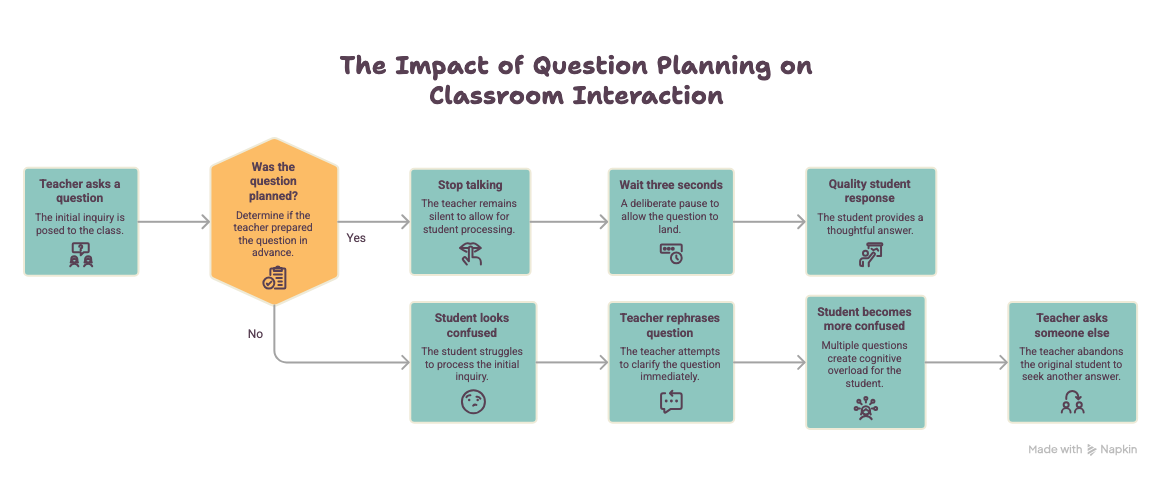
Wiliam was sceptical when he first encountered this finding. But having observed classrooms closely, he understands exactly how it happens. In many classrooms, the sequence goes something like this:
- The teacher asks a question
- The student looks confused
- The teacher immediately rephrases the question to make it clearer
- The student is now more confused — there are two questions on the table
- The teacher rephrases again
- The student has no idea which question to answer, so the teacher gives up and asks someone else
The question was never given a chance to land. And the root cause, as Wiliam identifies it, is straightforward: the teacher did not plan the question. An unplanned question gets rephrased in the moment, and rephrasing kills wait time before it has even started.
The practical implication is clear: plan your question, ask it, and then stop talking. Three seconds of silence — which feels considerably longer than it sounds — is enough to make a measurable difference to the quality of student responses.
There Are Two Wait Times
Wiliam identifies something that is often missed in discussions of wait time: there are actually two distinct moments where teachers can extend the pause.
Wait time 1 is the gap between the teacher finishing the question and a student beginning to answer. This is the one most teachers are aware of.
Wait time 2 — sometimes called elaboration time — is the gap between the student finishing their answer and the teacher beginning to evaluate it. In some classrooms this is effectively negative: the teacher starts evaluating before the student has finished speaking.
Extending wait time 2 is in some ways even more powerful than extending wait time 1. When a teacher stays silent after a student responds, students tend to speak into the gap — continuing, elaborating, refining their thinking. And when students are speaking, they are thinking. And when they are thinking, they are learning.
Think-Pair-Share — Done Properly
Think-pair-share is one of the most widely used strategies for building wait time into questioning — and one of the most commonly misapplied.
The typical version goes: teacher asks a question, students immediately turn to a partner and discuss, then the class shares responses. This is better than no wait time at all — but it misses an important opportunity.
Wiliam's recommendation is to not skip the think. Before students turn to a partner, they should have at least 30 seconds of silent individual thinking — retrieving what they already know, forming their own view. This is not wasted time. Retrieving something from memory actually strengthens that memory. Students who think first, then share, arrive at the discussion with something to contribute — and leave the discussion with a stronger, more durable understanding.
The sequence should be: think (silent, individual) → pair (discuss with a partner) → share (whole class).