Why Questions Matter

Two Good Reasons to Ask a Question
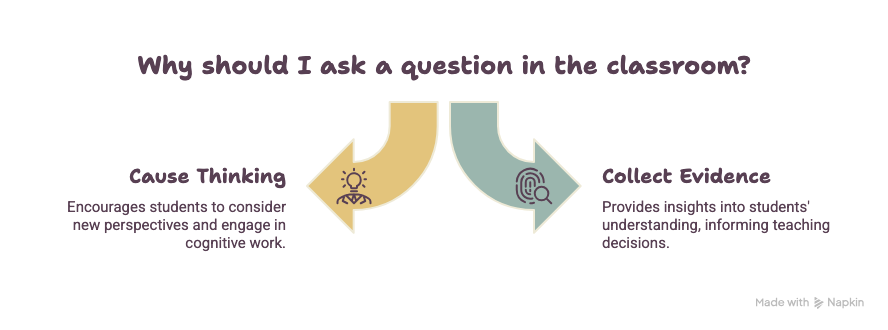
Teachers ask questions constantly — it is one of the most natural and instinctive things we do in a classroom. But Dylan Wiliam's research invites us to be more deliberate about why we are asking them. He identifies two core purposes:
- To cause thinking. A well-designed question makes students think hard about something they might not otherwise have considered. Its purpose is to create the cognitive work that produces learning.
- To collect evidence. A question can also be used to find out what is going on in students' heads — giving the teacher the information they need to make a better decision about what to do next.
Most experienced teachers are already doing both of these things intuitively. The shift Wiliam invites is simply to be more intentional about which purpose a question is serving — and whether the way it is asked is actually achieving that purpose for every student in the room.
The Problem at the Heart of Classroom Assessment
Here is the uncomfortable reality that Wiliam identifies. When we ask ourselves whether a lesson has gone well, what we are really asking is: will students remember what happened here in two weeks time? And that is a question we cannot answer in the moment.
Learning, as Kirschner and colleagues define it, is a long-term change in capability — a change in long-term memory. This creates a genuine tension for teachers. We need to make decisions in real time, lesson by lesson, while the evidence of whether those decisions have led to actual learning will only become visible weeks later.
The fact that a student can do something at the end of today's lesson does not mean they will be able to do it in six weeks. But — and this is the foundational idea — if they cannot do it right now, it is highly unlikely they will be able to do it in six weeks either.
This is why the questions we ask matter so much. They do not guarantee learning has taken place. But they are our best available tool for ensuring that the understanding students leave the lesson with is the understanding we intended them to have — rather than something at complete variance with what we were trying to teach.
As Wiliam puts it: teaching takes place in time, but learning takes place over time. Better evidence, gathered through better questions, leads to better decisions — and better decisions lead to better learning.