Key Takeaways

Module 1: Key Takeaways
Group Work vs. Collaborative Learning
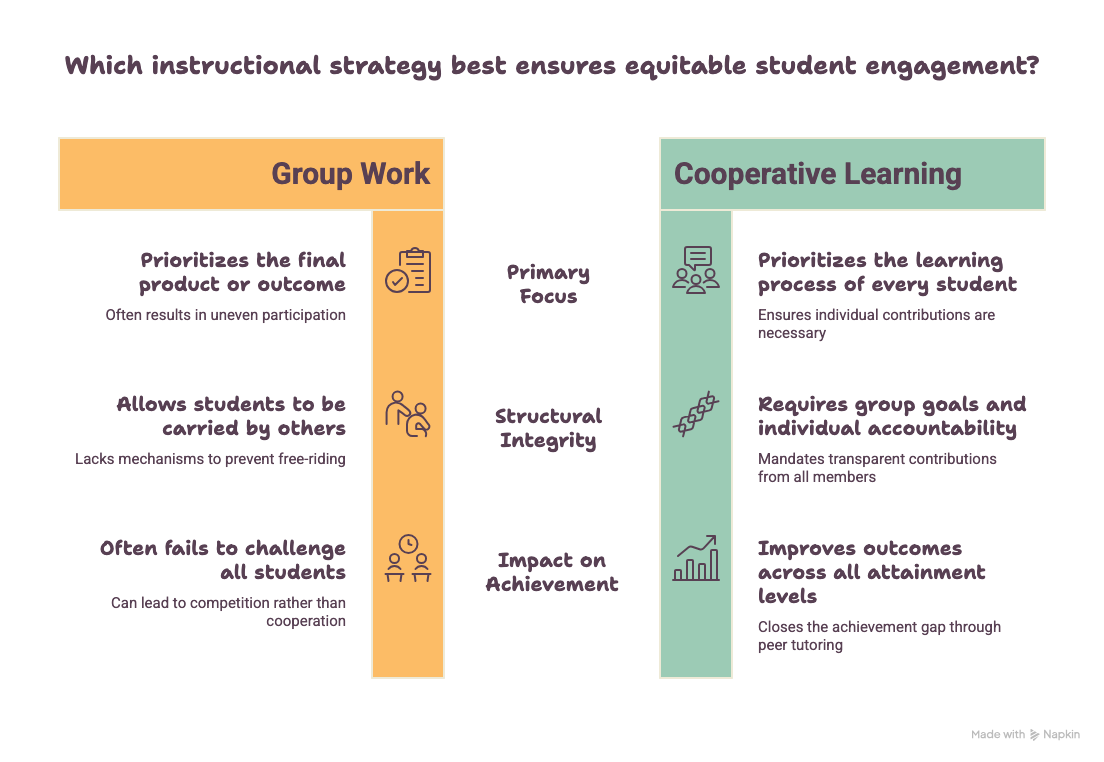
- Group work and cooperative learning are not the same thing — a group can produce a good outcome even when only one or two students do the work
- In a classroom, the outcome is not the point — every student's learning is the point
- Most group tasks are designed in a way that allows students to be carried rather than challenged — the solution is to design differently, not work harder
Two Conditions for Effective Peer Learning
- Cooperative learning works when — and only when — two conditions are both in place: group goals and individual accountability
- A group goal means every student's learning effort is genuinely necessary for the group to succeed
- Individual accountability means every student's contribution is visible to the rest of the group — not just present, but transparent
- Neither condition alone is sufficient — group goals without accountability allow free-riding; accountability without group goals creates competition rather than cooperation
Four Mechanisms That Make It Work
- Motivation: in a well-structured cooperative setting, it is in every student's interest to help their peers learn
- Social cohesion: students who care about each other try harder — not because they have to, but because they want to
- Personalisation: a peer who has recently navigated the same difficulty can provide targeted, accessible support that whole-class teaching cannot always offer
- Cognitive elaboration: those who give help often benefit more than those who receive it — explaining forces deeper thinking
Peer Learning and Every Student
- Well-structured cooperative learning improves outcomes across the full range of student attainment — not just for those who are struggling
- Peer tutoring is one of the three most cost-effective strategies for closing the achievement gap, alongside feedback and metacognition
- Mixed-ability grouping is generally preferable because it activates the cognitive elaboration mechanism — ability grouping removes that opportunity
- The key question is never just who is in the group — it is always whether both conditions are in place
In the Next Module
We have spent Module 1 establishing why peer learning works — the research evidence, the two essential conditions, and the four mechanisms that drive genuine learning for every student. In Module 2, we turn to the practical question: how do you actually structure peer learning in your classroom? You will explore a range of specific strategies — from the pre-flight checklist to the ladder of feedback — that make peer learning accountable, manageable and immediately applicable in your next lesson.