Four Mechanisms That Make It Work

Four Mechanisms That Make It Work
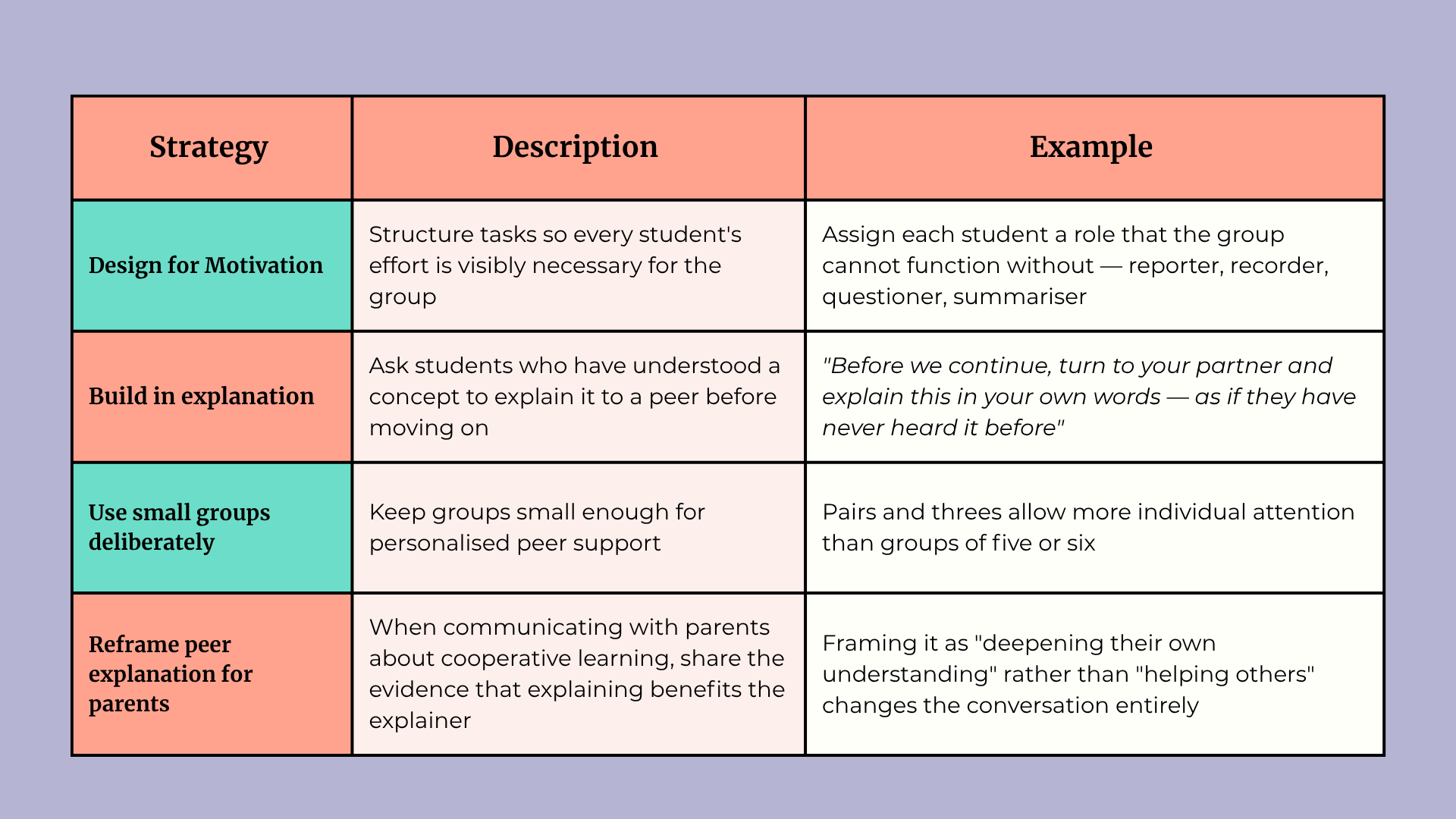
We have now established that cooperative learning works when group goals and individual accountability are both in place. But why does it work? Understanding the mechanisms behind cooperative learning matters — because it helps teachers design tasks that actively harness those mechanisms, rather than simply hoping that putting students together will produce learning.
Dylan Wiliam, drawing on Slavin, Hurley and Chamberlain (2003), identifies four mechanisms through which well-structured cooperative learning improves outcomes for every student in the room.
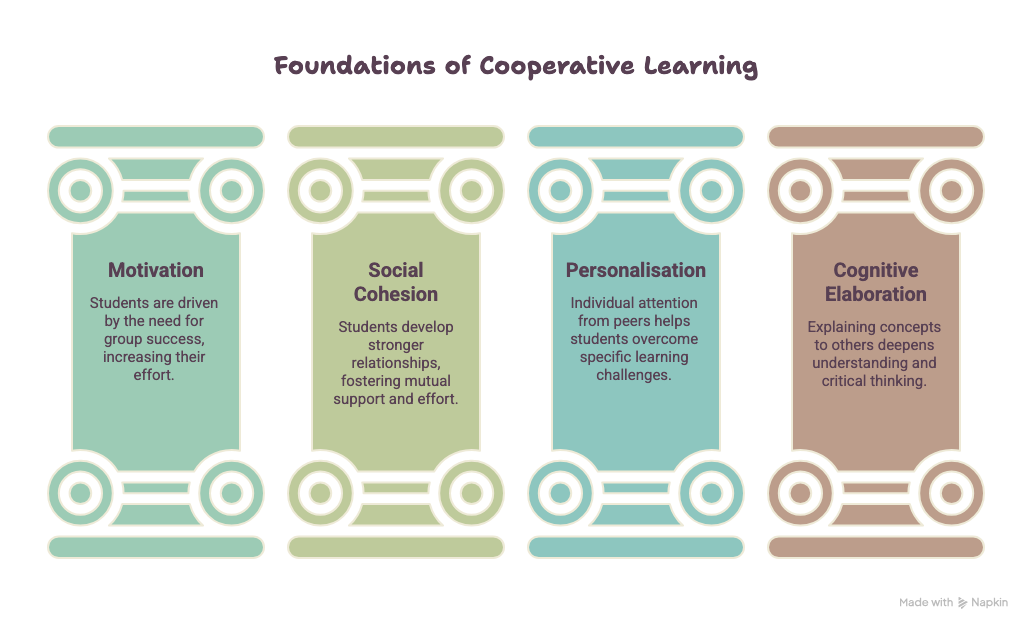
1. Motivation
In a well-structured cooperative learning setting, no student can succeed unless every student succeeds. This changes the incentive structure of the classroom in a fundamental way.
When a student knows that their group's outcome depends on their own effort, it is in their own interest to try. They are not helping their peers out of altruism — they are helping because the group's success is their success. And when effort is in a student's own interest, it tends to increase.
2. Social Cohesion
The second mechanism is less obvious but equally powerful. Wiliam quotes Abraham Lincoln: "I don't like that man very much — I must get to know him better."
When students work together toward a shared goal, they tend to come to know and care about each other more. And when they care about each other, they try harder — not because they have to, but because they want to. Social cohesion builds effort through relationship rather than structure.
This is one of the most underappreciated benefits of well-designed cooperative learning: it does not just improve academic outcomes, it builds the kind of classroom community where students genuinely support one another.
3. Personalisation
The third mechanism addresses something that whole-class teaching struggles to provide: individual attention.
In a small group, a more able peer can engage directly with the specific difficulty a particular student is having — in a way that a teacher managing thirty students simultaneously cannot always do. The help is targeted, timely and personal. And because it comes from a peer who has recently understood the same concept, it is often expressed in language that resonates more directly with the student who is struggling.
4. Cognitive Elaboration
The fourth mechanism is perhaps the most counterintuitive — and the most important for addressing a concern that many teachers will have heard from parents of higher-achieving students.
When students help each other in a cooperative setting, those who give help often benefit more than those who receive it.
Wiliam is direct about this. Most teachers will recognise the feeling: "I never really understood this until I had to teach it." The process of explaining a concept to someone else — what psychologists call cognitive elaboration, or spelling out what you understand — forces the explainer to think through their ideas more carefully, make better connections to other content, and consolidate understanding in a way that simply knowing the answer does not require.
This has a direct implication for a concern Wiliam frequently encounters: that cooperative learning holds back higher-achieving students by making them explain content to those who are struggling. The research suggests the opposite. The cognitive work involved in explanation deepens understanding, strengthens memory and develops the kind of flexible thinking that higher-achieving students most need.
Try It Tomorrow
📥 Download: Cooperative Learning in Practice
To help you see these two conditions and four mechanisms working together in a real classroom, we have created a booklet of sample lesson plans across a range of subjects. Each lesson plan is annotated to show exactly where and how group goals, individual accountability and the four mechanisms are embedded into the lesson design.
📥 Download the Cooperative Learning in Practice lesson plan booklet below