Two Conditions for Effective Peer Learning

Two Conditions for Effective Peer Learning
In the previous lesson we established that group work and cooperative learning are not the same thing — and that most group tasks are structured in a way that allows some students to be carried while others do the work. The question is: what does genuinely effective peer learning actually require?
Dylan Wiliam, drawing on the research of Robert Slavin and the Johnson brothers, is clear: cooperative learning works when — and only when — two specific conditions are in place.
Condition 1: Group Goals
The first condition is that students are working as a group, not just in a group.
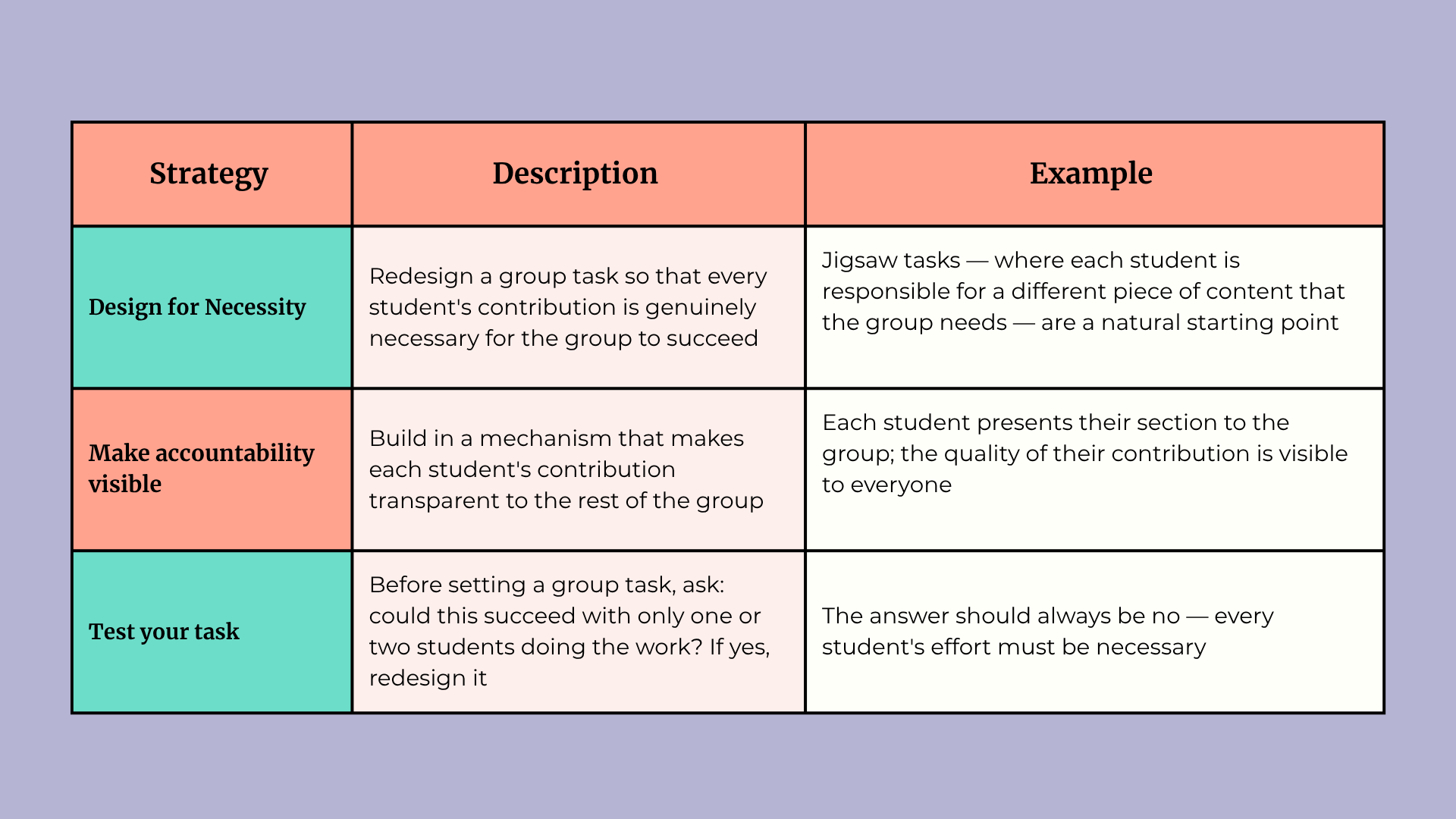
A group goal means that the success of the group depends on every member contributing. It is not enough for the group to produce a good outcome — the outcome must require the genuine learning efforts of every student in the group. If two students can carry the rest, the group goal has not been properly designed.
Wiliam illustrates this with two vivid examples that most teachers will immediately recognise.
In a school orchestra, one student who has not practised plays the wrong note — and it harms the entire group's performance. That is a group goal: the quality of the whole depends on the contribution of every part.
In team sport, one player who misses a tackle harms the whole team's chances of winning. Again, the group's outcome is directly affected by each individual's contribution.
The classroom equivalent is a task designed so that every student's learning effort is genuinely necessary for the group to succeed — not just present, but necessary.
Condition 2: Individual Accountability
The second condition is that every student in the group is individually accountable to the rest of the group for their contribution — and crucially, that this accountability is visible.
In the orchestra example, not only does the wrong note harm the group's performance — everyone knows who played it. In the football team, everyone knows who missed the tackle. The accountability is not just present — it is transparent.
This is what makes individual accountability so powerful and, as Wiliam acknowledges, so difficult to implement in academic settings. In most classroom group work, a student who does not contribute can remain invisible. Their lack of effort does not harm the group visibly — someone else compensates, the task gets done, and the disengagement goes unnoticed.
Genuine individual accountability requires that one group member not doing their part noticeably affects the outcome for everyone — and that every member of the group is aware of who is and is not contributing.
Why Both Conditions Must Be Present
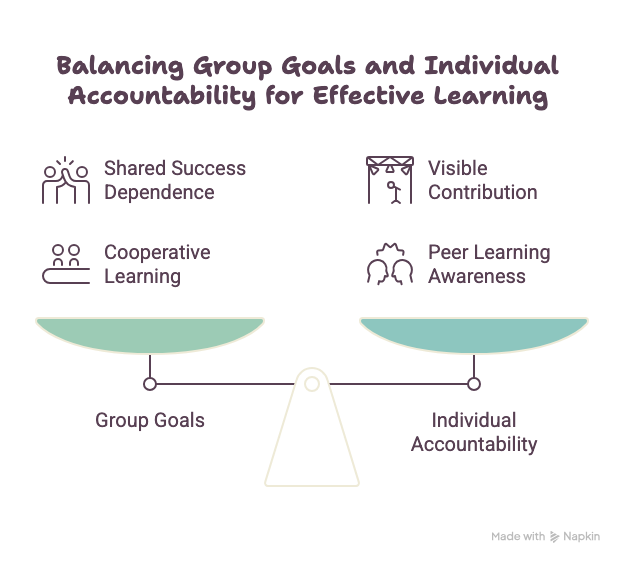
Wiliam is explicit: both conditions must be present for cooperative learning to work. Neither alone is sufficient.
Group goals without individual accountability allow students to free-ride — to benefit from the group's success without contributing to it. Individual accountability without group goals creates competition rather than cooperation — students may each do their own work, but they are not genuinely learning from or with each other.
It is the combination of the two — working together toward a shared goal, with each student's contribution visible and necessary — that creates the conditions for genuine peer learning.