More Than One Teacher

There Is More Than One Teacher in This Room
Most teachers will recognise this scenario immediately.
A group of four students are working together on a task. The teacher circulates, glancing at each group in turn. From the outside, the room looks productive — students are sitting together, there is discussion, work is being produced. The lesson feels like it is going well.
But look more closely at one of those groups. One student is writing. One is watching. One is on their phone. And one is staring out of the window. The task has been completed — but by one student, not four. And the teacher, moving between groups, has no reliable way of knowing.
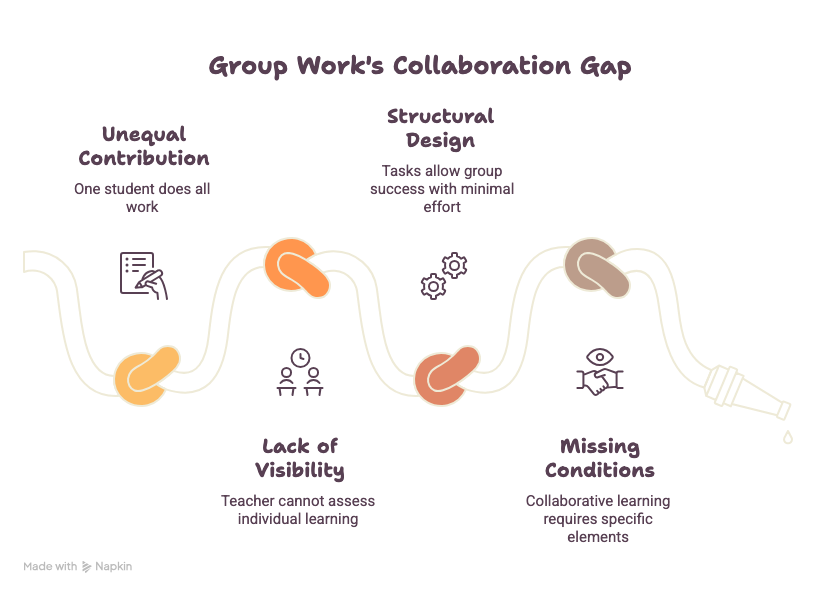
This is the gap at the heart of most group work. And it is not a criticism of the teachers who use it — group work is a well-intentioned and widely used approach. The problem is structural: most group tasks are designed in a way that allows the group to succeed even when only one or two members do the work. When that happens, the students who most needed to learn something have not learned it — and nobody in the room knows.
Dylan Wiliam is direct about this. The research on collaborative learning is, in his words, a research success story — but only when two specific conditions are in place. Without them, group work produces the appearance of collaboration without the substance of it.
This course is about what happens when you put those conditions in place — and what becomes possible when every student in the room is genuinely activated as a learning resource for every other.
The Real Purpose of This Course
This course, grounded in Dylan Wiliam's research, will help you move from group work that looks productive to collaborative learning that genuinely is — for every student, not just the most motivated or articulate. It is built around two interconnected goals.
1. The Case for Peer Learning
We will begin by establishing why peer learning works — when it is done properly. You will explore the research evidence, understand the two conditions that make collaborative learning effective, and examine the four mechanisms through which peer learning improves outcomes for every student in the room.
2. Practical Strategies for Peer Learning
Knowing that peer learning works is one thing. Knowing how to structure it so that every student is genuinely accountable and genuinely learning is another. You will explore a range of practical strategies — from the pre-flight checklist to the ladder of feedback — that make peer learning manageable, measurable and immediately applicable in your next lesson.
Because when students are genuinely activated as learning resources for one another, something remarkable happens: the classroom stops being a place where one teacher tries to reach thirty students — and becomes a place where every student is helping every other student learn.