What is Metacognition?

Flavell (1976): Defining Metacognition
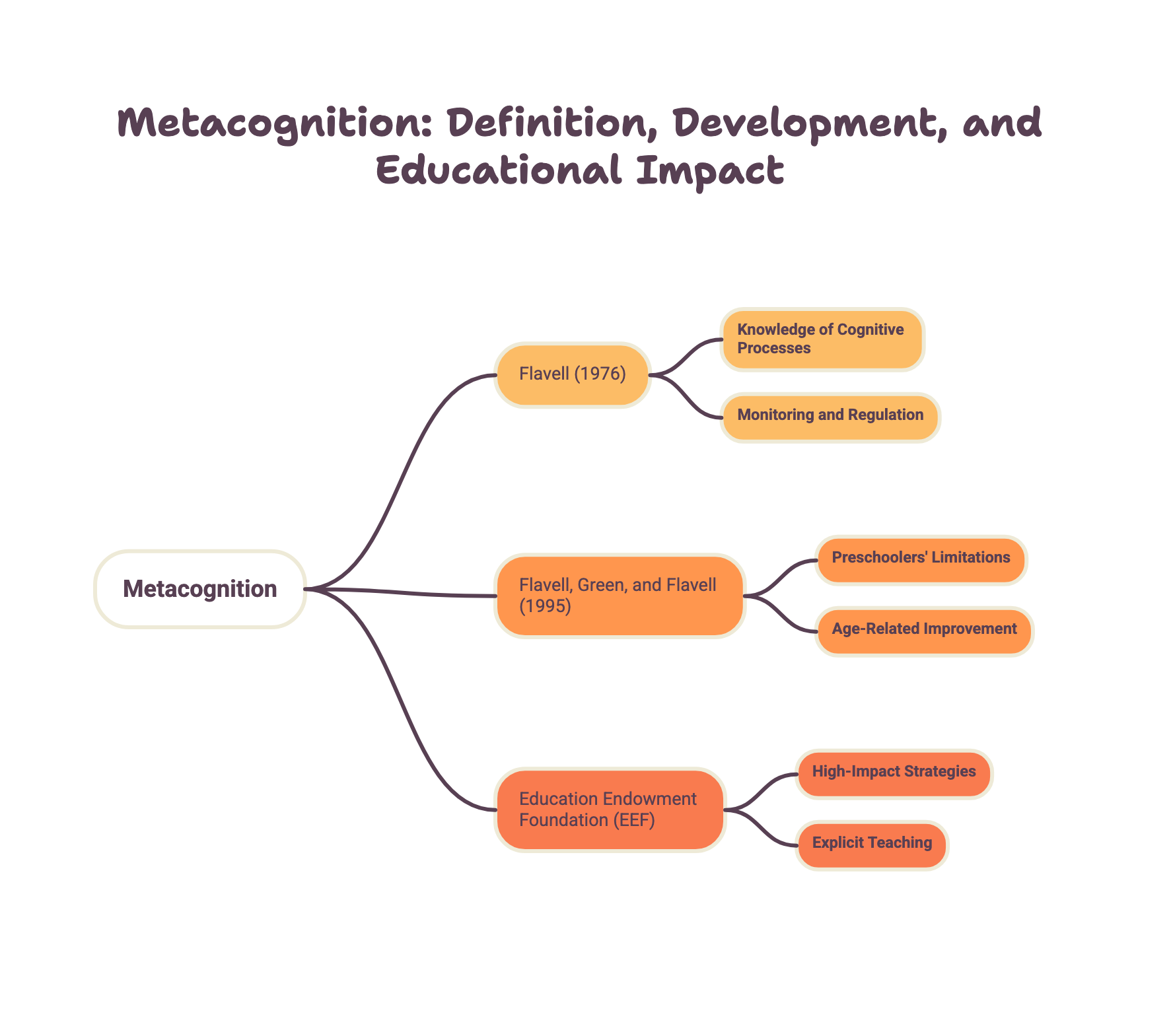
The term itself comes from psychologist John Flavell, widely credited with coining it in 1976. He defined metacognition as one's knowledge concerning one's own cognitive processes — and, just as importantly, the active monitoring and regulation of those processes in service of a goal. In plain terms, metacognition includes three things: knowing what you know, knowing what you can do, and knowing something about your own cognitive abilities. A student with strong metacognition doesn't just complete a task — they have a running awareness of how well they're doing it, and what they'd need to change if they weren't.
Flavell, Green and Flavell (1995): How This Develops in Children
Flavell went on to study exactly when and how this ability develops, publishing a major research monograph on young children's understanding of thinking. What he and his colleagues found was that preschoolers are surprisingly poor at recognising when they themselves have just been thinking, and at recalling what they'd been thinking about — even in situations specifically designed to make this easy. By age 7–8, however, this ability improves considerably. The takeaway for teachers: metacognitive awareness isn't something children either have or don't have. It's a skill that develops with age — and, more usefully for us, with practice and explicit teaching.
The Education Endowment Foundation Teaching and Learning Toolkit
The Education Endowment Foundation's Teaching and Learning Toolkit ranks classroom approaches by their impact on student progress and their cost to implement. Teaching approaches that explicitly help students plan, monitor and evaluate their own learning — in other words, approaches that build metacognition — rank among the highest-impact strategies in the entire Toolkit: worth an average of eight additional months of progress, backed by extensive evidence, at low cost. Very few classroom approaches offer that combination of high impact and low cost. But the evidence is clear on one condition: these skills have to be explicitly taught. Students don't develop strong metacognition simply by being told to "think about their thinking" — they need structured opportunities to practise it, which is exactly what Module 2 of this course will give you.
What This Means for Metacognition
Taken together, these findings tell us something important: metacognition is a specific, learnable skill — not a vague personality trait some students happen to have and others don't — and building it deliberately is one of the most cost-effective investments a teacher can make. But knowing what you don't understand is only half the story. A student can have excellent metacognitive awareness and still do nothing about it, if they don't care enough to act. That's exactly the gap our next lesson addresses: motivation, and why metacognitive skills only matter if students actually want to use them.