The Research Case for Self-Assessment

The Research Case for Self-Assessment
Self-assessment sounds like a soft skill — something nice to have, but not something that moves the needle on actual learning. The research says otherwise, and it's worth spending real time on why.
Sebba, Deakin Crick, Yu, Lawson, Harlen and Durant (2008)
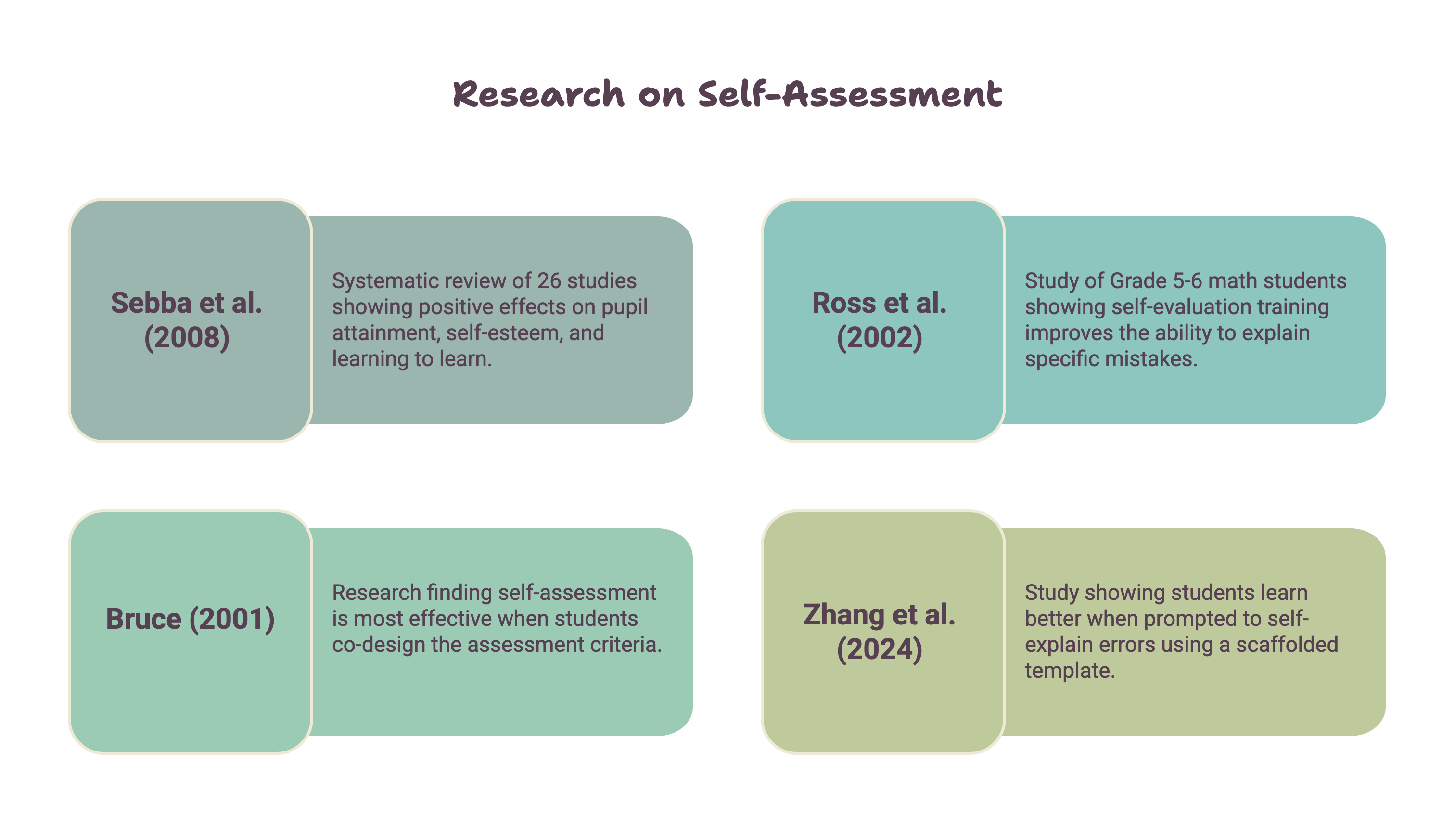
The most comprehensive evidence comes from a 2008 systematic review by Judy Sebba and colleagues, who synthesised 26 separate studies on self and peer assessment in secondary schools. Nine out of fifteen studies that measured pupil attainment found a positive effect. Seven out of nine studies measuring self-esteem found a positive effect. And most strikingly, seventeen out of twenty studies found improvements in what the researchers called "learning to learn" — goal-setting, clarifying objectives, taking responsibility for learning, and increased confidence. Self-assessment's biggest impact isn't a single test score. It's a shift in how students relate to their own learning process.
But averages across 26 studies only tell part of the story. It's worth looking at what specific studies actually found happening in classrooms.
Ross, Hogaboam-Gray and Rolheiser (2002)
One study reviewed by Sebba's team looked at self-evaluation training with Grade 5–6 students in mathematics. What Ross and colleagues found wasn't just improved scores — it was improved discussion. Students who had been trained to self-evaluate got noticeably better at explaining their own mistakes, not just identifying that they'd made one. That distinction matters. A student who can say "I got this wrong" hasn't learned much. A student who can say "I got this wrong because I confused these two steps" has learned something they can act on.
Bruce (2001)
A separate study, by Bruce, points to why that happens. Bruce found that self-assessment worked best when students were involved in co-designing the criteria they were being assessed against — rather than simply being handed a rubric someone else wrote. When students help build the criteria, the goals of the learning become clearer to them, because they've had to think through what "good" actually looks like before they ever attempt the task.
Zhang, Qian and Fiorella (2024)
This isn't just older research, either. A 2024 study by Zhang, Qian and Fiorella looked at how students learn from their own errors when solving complex problems, in this case in physics. They tested whether redesigning feedback visually helped students learn more — it didn't make much difference. What did make a difference was prompting students to self-explain their errors, especially when that self-explanation was scaffolded with a template. Students who were prompted to explain, in their own words, why they'd gone wrong performed better on near-transfer tests and were more likely to correct the error successfully next time.
What This Means for Self-Assessment
Put these three findings together with the Sebba review, and a clear pattern starts to form. Self-assessment doesn't work simply because students are asked to look at their own work. It works when students are asked to think about their own thinking — to notice what they don't yet understand, to explain why an error happened, to judge their work against criteria they've helped shape. That kind of thinking has a name: metacognition. And that's exactly where we're headed next.
There's a second pattern, too, sitting quietly underneath all of this. None of these strategies work if a student simply doesn't care to use them — if they glance at their own mistake, shrug, and move on without engaging with it at all. Self-assessment only changes outcomes when students are motivated enough to actually act on what they notice about their own learning. That's the subject of our third lesson in this module.
So before we get to the practical strategies in Module 2, we need to understand these two ideas properly: what metacognition actually is, and what drives a student to use it. That's where we're going next.